Paris, Malaucène

Went to the Bibliothèque Nationale yesterday to see an exhibit of rare books, including some of Apollinaire's handwritten revisions of the first or second proof of 'Le poète assasiné.' And Mallarmé's extensive revisions on proof of 'Le coup de dès,' Proust's dedication of the first edition of "La Recherche' to a friend with whom he was less and less on good terms ("Chère Madame..."), a copy of a book Picasso illustrated and that he gave to Dora Maar, whom he portrayed as a harpie. Looking at the revisions of manuscripts and manuscript proof made me feel how improvised everything is, how open to change, how imperfect in its author's mind as it goes to press. Afterthoughts, afterthoughts, and then they come down to us as if engraved in marble.

Photo by François Brahic

Photo by François Brahic

The picture on the right was taken in the village of Malaucène, at the foot of the Mont Ventoux. It was Christmas Eve, about 6:30 pm, according to the clock up top, by the moon. Shops were closing. We'd stopped off after a hike on one of the Mont Ventoux trails (the GR4) to buy some last-minute gifts in a little bookstore, and some eau de lavande at the pharmacy.

Malaucène is one of the places cyclists begin or end their ascent of the Mont Ventoux, and it is also where Petrarch set off on his "Ascent of the Mont Ventoux" in (I think) 1336. The pharmacy is behind us in the photograph beside a mossy fountain, a butcher shop and a bike store; the bookstore is beyond the lit archway (the sign points to to it) in one of the narrow streets. Also behind us, on the main street, a supermarket, where we buy groceries.
The Persimmon Tree and the Family Tree

photo by François Brahic

photo by François Brahic

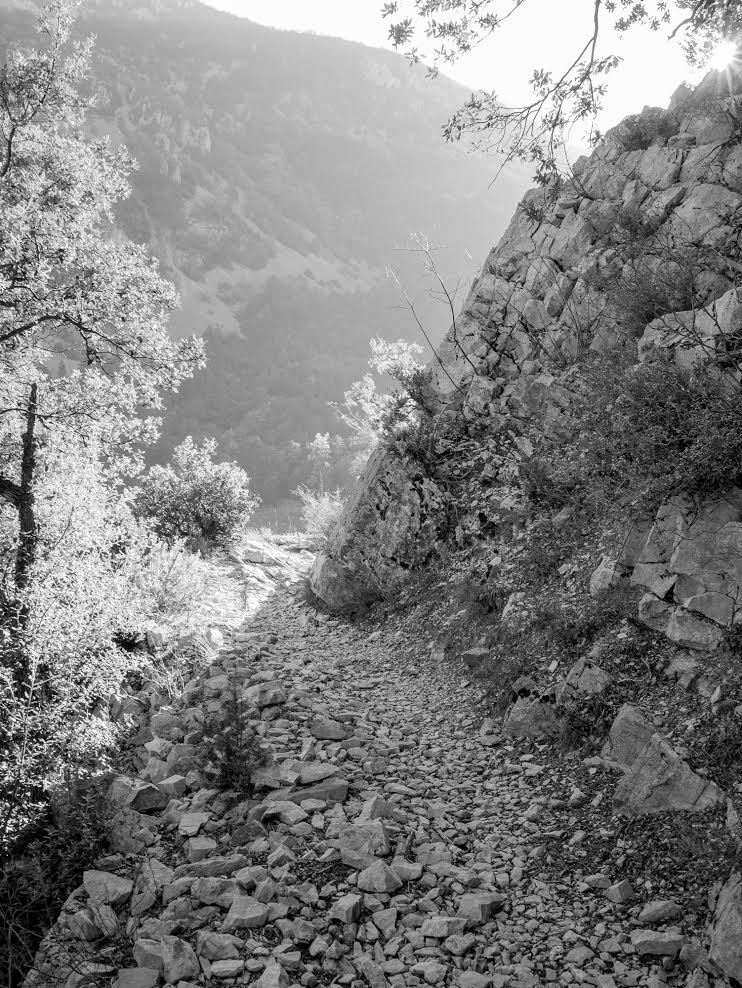
I can't sum up two weeks offline. Besides my blog philosophy is that it should be short and full of particulars. I could have kept it going by a) sitting on the steps of the village library in freezing temperature and whiplash mistral; b) sitting on my brother-in-law's doorstep in ditto. In fact, the weather was so cold and blustery, though mostly sunny, last week that we had to force ourselves out of the house after lunch for walks. We made it halfway up the Mont Ventoux at least three times and nabbed some persimmons on the way. This involved a long conversation with the custodian of the tree, whose father had planted it, about seventy years ago, when the present "owner" (if trees are owned) was ten years old. He climbed a ladder, we held up a box he also provided. It turned out he and my husband were cousins, after they exchanged family trees--the persimmon tree and the family tree.

Back to Paris last night. I finished my almost-finished Knaussgaard (too fat to transport, besides I had Ferrante, whose more conventionally-organised narrative makes it easier to read when there are a number of other people in the house, all doing their things: slow-cooking a leg of boar shot by our next-door neighbour and offered with great ceremony to us; playing "bananagrams," a speed version of Scrabble, in case, like me,  you didn't know; playing the flute; slow-cooking pork; vacuuming; moving beds; making exquisitely folded paper objects; photo-shopping the day's photos...).

I think I'll add a few photos to this, if i can get my son to send them over from the next room. Stayed tuned.


Knausgaard, again

Is it worth reading Knausgaard from beginning to end? Why would it be worth it?

What doesn't change is the tediousness of his account of his life--which is the tediousness of everyone's life, I suppose, the ups and downs, the trivial along with the momentous. Taking out the garbage, watching his wife give birth, shitty diapers, a suicide attempt. Of course, not everyone could report these things is such obsessive detail and still have people read past the first chapter, so this in itself is an accomplishment. If I have nothing else to do I am not discontent to plough through these daily details, because of the chutzpah of even thinking about writing all that down, and his puritanical honesty about his feelings, no matter how they may reflect on him. 

What does change, and give the book an "arc" are his developing reflections on how meaningful or meaningless all this is. Meaningful, I guess, because his success as a writer, this is in the background, in the interview requests, that confers meaning on his life, and that means everything to him too. It's not something he's going to sacrifice to a marriage and children. 


Knausgaard, again. South for Christmas.

Knausgaard is getting boring. I'm just turning the pages, pretending to read, because psychologically it is almost impossible for me to stop reading something before the end. ( Ok, I should learn.) I took tome 2 to a doctor's appointment: she had said, "Bring a book, I'm not very punctual," which was an understatement. It was two hours before my turn came, two hours after the appointment time. Fortunately the doctor was smart, humorous. It doesn't help to have a book when you are getting mad. And there are only so many issues of Elle magazine you can bear to read in one afternoon.

Tomorrow off to the south of France for two weeks. Looking forward to lots of hikes, up the Mont Ventoux etc. The house belonged to my husband's great grandfather. It was last decorated by my mother-in-law and is a museum of a certain southern French style, the furniture and kitchen stuff that got relegated to the country when their Marseille house was updated. It's dans son jus, as they say.

Lunch, rain, Knausgaard

Just back from having lunch with a friend at the Centre Pompidou, where there was a long line of people waiting to enter when the Centre opened, at 11. Nina and I had planned to meet at Brancusi's Atelier on the parvis, but it wasn't open either, and when I arrived Nina was standing outside under an umbrella, and we went to the Cafe Beaubourg up by the Niki de St Phalle/Tinguely fountain.

Knausgaard: it's very good, I think. (Deliberately) not beautiful writing (the way Sebald is consciously beautiful writing) but gripping in its unfolding, the story of his "struggle" to find meaning in existence, developed alternatively in passages of narrative and passages of essayistic discourse, all on a forthrightly personal level. I don't want to rush through it, want to take time to understand why it seems important as a book.

Or perhaps

I just like melancholy (Sebald). Comes of growing up in a rainy climate?

Raining here today. Angular shadows on the church? Forget it. Wet zinc roofs instead.

A couple days ago I started reading Knausgaard, Book 2, which I picked up in London in a cheap paperback edition that looks like it would melt to pulp if I left it out in the rain. Maybe that would be a good thing. This is fucking boring, I thought, as I started reading the first of its 523 pages. Slowly I'm getting hooked. Does he think he's the only person who was stultified by spending his days tending small kids? Well, at least he's honest about it. I cringe even at admitting it wasn't the best of worlds. He manages somehow to balance his love for his kids with his distaste for child-minding. Not that easy to pull off.

Well, back to work.

Sebald the poet

Sun, blue sky, sharp shadows on the church and other buildings. I stand at the kitchen window looking across the immediate rooftop to the buildings behind. And behind them, I know, though I can't see, are courtyards, gardens even, and then another wall of buildings on the next street. I like the idea of these secret courtyards, mostly hidden from the street, until out walking you catch a glimpse of them through an open doorway. Maybe the concierge is there with a brush and a bucket, scrubbing the cobbles. Don't try to get past her. She will protect her domain. Such spaces between buildings exist all over Paris, grand and humble, private.

When I was in London I bought a collection of Sebald's poems called Across the Land and the Water. I began reading it a couple of days ago. It begins with poems he wrote as a student, in England and travelling in Europe, and that's the part I've read so far. It is recognizably Sebald, even-tempered, landscapey, ironic, human actions observed with no-comment detachment. It's the voice that feels already authentic, as if he weren't trying to write poems, simply to say best what he feels. It feels stripped of style and that, I guess, is the sign of consummate style, from the outset.

I finished my draft translation of one Cixous book yesterday, and am going back to revise the translation of another, Chaptre Los. 

In a week we head south for Christmas.


Bach

A concert, yesterday, Sunday, at 12:30 in the Eglise St. Louis en L'Ile. The church, small and elegant, has a connection with the Crusades: Louis IX is said to have prayed on the Ile St Louis,  then a cow field, before going off to deliver Jerusalem from the Infidels. Louis XIII had the island developed and the new inhabitants requested a church. The church that is now the parish church has been much rebuilt--originally much plainer but baroquized in the nineteenth century, with gilded sunbursts, gilded flutings of the pilastres and on the acanthus leaves of their capitals. A new organ, built by Bernard Aubertin after the German organ builder Zacharias Hildenbrandt, was installed in 2005.

The concert was an organ recital of works by Bach. It lasted half an hour. It was very good. Greatly plain.