Fahrenheit

Blue sky back, sharp-angled shadows on the stones of the church across the street, pigeons sunning on the heads of the saints and martyrs. While I wait for the kettle to boil  I look out the kitchen window at the round, clock-face thermometer on the back porch: 40° it says. That would be fahrenheit.

The clockface--picture an old-style schoolroom clock-- comes down to me from my maternal grandparents'; it is homemade. My grandfather was something of a handyman. It has some tiny black and white snapshots of the family home in Saskatoon, Saskatchewan (Canada) and my grandparents, my mother and my aunt and is dated 1928. The pictures are somewhat roughly cut out of bigger pictures.  I lived in that house for the first years of my life. My father was overseas and my mother was not supposed to be pregnant: "We thought you'd wait," my mother told me (late in her life; she was not necessarily a reliable narrator) her parents told her when she turned up pregnant after my father's deployment. "Wait," I guess, till the war was over, in case she needed another husband, which would be easier if there wasn't already a child in tow. Or at least that's how I heard the story. My younger sister's version is that our grandmother gave our mother hell for being with child. Who knows where the truth lies? 

Anyway, 40° fahrenheit this morning, sharp shadows, harpsichord music from the living room where my husband is practicing (practising?) 
 

Short term, long term

I seem to have caught up with a number of projects, translations, journalism. The big project of course is the poetry manuscript which I have been ordering and reordering, trying to see individual poems objectively and being ruthless about trimming or eliminating them; trying also to have their arrangement--what follows what--coherent. This can be done by something as simple as changing a title, or a tiny reference, but ideally all the poems are somehow reflective of the same, personal reality, and this is much harder to accomplish.

Of course some books of poetry have a project at the outset--they write about this or that--the 1918 flu epidemic, for instance--but mine doesn't. The small picture is personal, the larger one has to be more universal. This is difficult. And slow.

Weather still cold and damp. It blurs the edges of things, the moisture in the air. 

The journalistic projects: mainly reviews. The latest one is about done. I like these. I enjoy writing them and I like seeing my byline in print: short-term gratification.


Büches de Noël

California celebrates rainfall is today's news. I heard from friends whose students have just won Rhodes scholarships, one of whom (the student) had been memorably articulate in Montaigne class I audited; my friends mentioned umbrellas, puddles, mud.

Here in Paris it is cold, on the cusp of freezing, which is to say the drizzle coming down looks and feels like sleet. I take my gloves when I go out, and then stuff them into my backpack for fear I'll lose them, like my reading glasses, somewhere, a week ago. An inexpensive drugstore pair, but I liked the Japanese fabric of the case, and anyway I hate losing things, as Elizabeth Bishop said. And also Robert Hass: all the new poetry is about loss, like the old poetry. 

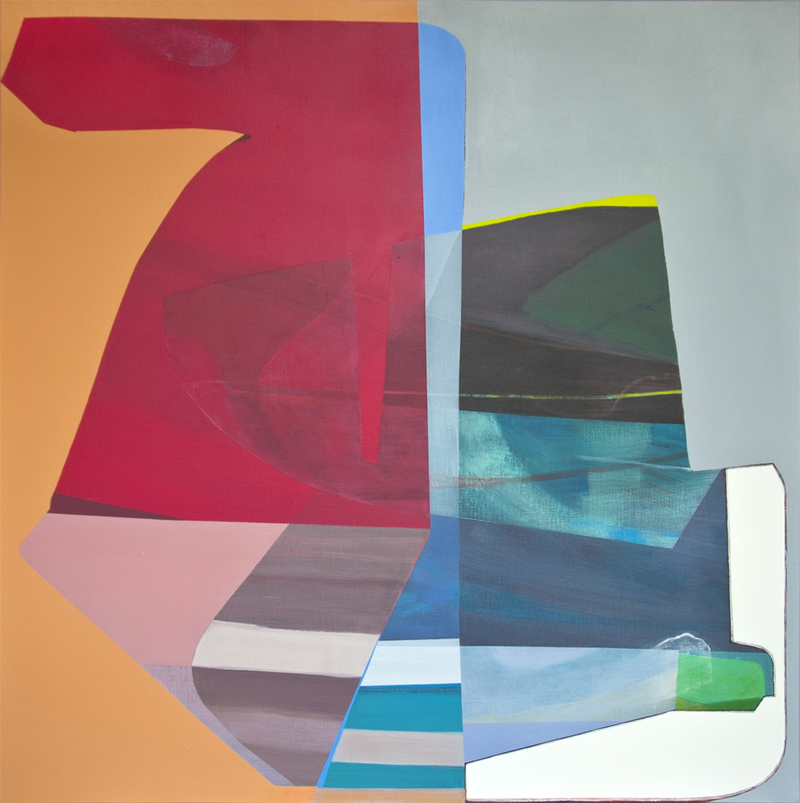
I visited my friend Susan Cantrick yesterday. We talked and looked at her year's worth of work, which includes the large painting to the right of this paragraph; then we went to a cafe and talked some more. And then it was getting close to dinnertime; she walked home and I walked back to the Metro past flower shops full of fake firs with fake snow, some of it bright red, fuchsia. We will not have a Christmas tree, but maybe an olive tree branch, since it will be olive-tree-pruning time of year. 

An hour or so ago I rang the pastry shop in Carpentras to order bûches de Noël for 17 + people. Kerfuffle in the background. I pictured the receiver lying on a counter near some string for wrapping packages (with a loop for one's finger, so they can dangle without the contents shifting). At last someone came to the phone, apologised and asked if I would mind calling back later: they have a new system for the bûche de Noël orders this year, and it is not "à point" (working). They have, in fact, computerised the system. No more fat school notebook with the orders recorded in Madame Jouvaud's pale blue handwriting. Madame Jouvaud died in August. 

Simultaneously

Coming back from the Sonia Delaunay show at the Paris Museum of Modern Art I crossed the Pont d'Alma and took the new pedestrian route along the quais. I used to drive along this route to get to my teaching job at the British School in Croissy-sur-Seine. It has been closed to cars, and, I discovered, a few days ago, turned into a wonderful place to walk, out of earshot of traffic (mostly), but within hearing of the river traffic, currents, waves...there are people biking, jogging, playing board games on tables and in little huts. There are pocket playgrounds and climbing walls. There are places to stop and eat and drink, more or less formally, railroad ties arranged as benches. Under one bridge there is music to dance to, and a little girl, walking with her parents, began dancing, like an automat, as she passed under the bridge.  There was a big silver tent in which people were learning to tango--this was an all-afternoon-into-the-evening event for beginners and experts--and I went in and regretted that it was just a little too far from home (it was on the quai below the Musee d'Orsay) to bring my husband back to.

The Delaunay show? Mixed feelings. Loved the gouaches and paintings, less interested in her fashion and upholstery business, even if it contributed to her return to abstraction post-World War 2 and the work I do love. If she had been recognised earlier in her life, might she have--with that encouragement--developed more as a painter?


Quiet

A quiet Saturday, with books, watching the shadow stretch across the walls of the buildings outside, and on those inside too: three sheets of music tacked to the wall over my desk each extend an elliptical strip of shadow to the left; the button on a closet, the door doubled by its darker shadow.

My family has been here. Yesterday they flew back to the US. The day before we went to the Jardin des Plantes and the Museum of Natural History, which was full of lyçée students sketching stuffed animals or filling out questionnaires. Afterwards we had mint tea at the mosque and cakes, poked our noses into the hammam, and walked back home along the rue Mouffetard.

Went

down into a tunnel in London and came up, 2 hours later, in Paris, where the weather was much better. Dry roof tiles instead of damp. A few stars. Spent most of today in the Luxembourg Garden, sitting on a bench in the playground watching Lucie go round and round on the zip line, and thinking about why a seven-year-old would want to spend her day lining up, jumping on, going round, repeat. There was the obvious physical pleasure of spinning through the air, as on a swing, but slightly different, since there is a track and some distance is covered. But maybe equally pleasant the presence of potential friends. "I'm bored," meant the latest new friend had gone home. Eyes rolling meant the new friend had abandoned her for either another new friend or an old friend. Is this how most seven year old girls behave or only some of them? What if, unlike Lucie, they are shy or, heaven forbid, unsociable? How hardwired would that be?

It is slowly getting dark at 5 pm. Tea noises from the kitchen. Card game noises from the living room.

Came back with a pile of new books: Boland, Vona Groarke, Hugo Williams, Maurice Riordan, Sebald, Harry Mathews, Kathleen Jamie, Stallings, May Lan Tan. 

Tate etc

Did some work this morning, then, after lunch, I took a bus to St Paul's and walked across the footbridge to the Tate Modern. Looked at the giant tapestry in the turbine hall, then the Surrealist collection, in itself a reason to be there. Then the view from the espresso bar across the Thames to the London skyline, with the dome of St Paul's smack in the middle. Sat there and read my book (Eavan Boland's new collection from Carcanet) for a while, before going to see the Louise Bourgeois' works on paper,' which interest me more than her sculpture, I think. They range from some small, early, already sophisticatedly naive pencil drawings (two boys in a bathtub, for example, but the bathtub is transparent) to a patch work composed bits of cloth left over from the family business--repairing tapestries--in Antony, a southern suburb of Paris. Some of the squares of fabric bore stitched-on name tags, of the kind a child going away on a  'classe de nature' might have stitched into their clothing--honest-to-god  machine-embroidered name tags. And buttonholes, beautifully stitched buttonholes. 

Got on the wrong bus to come home. 

England's green and pleasant land

I have just returned to London after a visit to Manchester, a first for me. Taking the train up I was astonished at the beauty of the English countryside, even at this time of year. I think what struck me most, as a Canadian with roots in the much more sublime landscapes of the North American west, was the human scale of the land: rolling green fields, hedgerows, streams and canals, farms, cows, sheep, a man walking in a field with a dog. The clouds were low, sometimes very dark, but the sun was shining through and the leaves were yellow, some on the ground, a lot still on the trees. I thought I could get down and sit in one of those fields quite happily, for a long time.