Two wheels better

My biking husband having rammed a car from behind and suffered mild damage to a knee and having been told to stay off his bike for a while, which means he needs the car to get to work, I have become more dependent on my bike for transportation. Which I find I enjoy.

I've been exploring routes to the places I go. I have traded my short-but-riddled- with-car-traffic route to campus, for a longer route that lets me glide under the train tracks we now live on the wrong side of, instead taking the automobile overpass. The friendly little bike and pedestrian tunnel leads to a bike path along the tracks. Sometimes a homeless man settles there, a kind of itinerant peddlar, with colourful bundles spread around him, hailing passersby. A fixture. Sometimes a train whistles by, on the other side of a wire fence you'd have to be pretty determined to get over (some people are). The bike path runs behind a medical centre, a shopping mall and the high school football pitches. It takes me almost the whole way to an opening in a fence with direct access to campus, via more sports fields (grass hockey, baseball, volleyball, a collection of swimming pools and a sport I don't recognise played with polo-type bats).

I could probably get to Ikea on my bike too, but I may not be ready for that yet. No train in that direction, but a 6-lane interstate highway to cross. And how would I get my big boxes back home?
 

Frank Bidart, "The Fourth Hour of the Night" (Poetry Magazine, May 2015)

(from Part X, the Taoist Master to the Great Khan)


Because you could not master whatever

enmeshed you


you became its slave — 


You learned this bitterly, early.

In order not to become its slave


you had to become its master.


You became

its master.


Even as master, of course, you remain its slave.


I was listening to Bidart read his poem this morning and when I came to these lines they felt like a commentary on the argument I was having with myself here yesterday: mastery versus refusal of mastery (or is it the appearance of the refusal of mastery?) or Yeats and Auden versus Beckett and Zbigniew Herbert. I suppose mastery is another word for power, over words, over people. Blanchot in The Book to Come, which I am still reading, has a chapter on Beckett in which he analyzes Beckett's silences, that I think is relevant, too, although I only partly understand it. Bidart's poem is a take on the whole existential problem of why write--and a lot of other things--being itself the performance of this argument in a long narrative poem ostensibly about power, or mastery. I was skeptical when I began to listen to it; by the end I felt Bidart had--had what? Well, he moved me.


"All changed, changed utterly: a terrible beauty is born."

I am rereading Yeats' "Easter 1916" along with a commentary on it, and thinking about how the words "terrible beauty" came to mind looking at the ruins of the Twin Towers and  video of 9/11. The fascination people ("we") feel, replaying the event mentally, our total recall years later of where we were when, the promptness with which pretty much everyone can remember and recount "their" 9/11. What's the compulsion to say "I was there'?

Here's what Langdon Hammer has to say about "Easter 1916" in a Yale University lecture I happened upon:

"How can something be changed utterly? [...] I said that Yeats looks on the modern with a sense of both horror and a fascination, a compulsion almost. Well, it's a "terrible beauty" he sees that draws him in this way. He sees, specifically, the passion of the revolutionary's act and he finds it beautiful. Yeats aestheticizes their political action. He finds beauty in it, it seems even or especially because it is terror-filled... ".

No one could write a poem like "Easter 1916" or even Auden's "September 1, 1939" today. Not using that tone. Many more layers of irony--and a different kind of irony from either Yeats's or Auden's--are required. You'd have to examine much more closely, and more skeptically, our fascination with the terror and the beauty, the passion of people ready to die for what they believe. Yeats believes in heroes, even as he questions his own admiration and their actions; Auden knowingly left his shield on the battlefield and writes about that, and then later, tellingly, about "The Shield of Achilles." Zbigniew Herbert, whose position and language I feel sympathy for, in "Five Men" shows us prisoners the night before they are to be shot, talking about "an escapade in a brothel / of automobile parts /...how vodka is best / after wine you get a headache...":

          five men 

          two of them very young 

          the others middle-aged


          nothing more

          can be said about them


Yeats and Auden, like Paul Muldoon, are virtuoso writers of verse. Herbert has another esthetic--Herbert couldn't have written the poems he wrote using the vision and highly-wrought language of Yeats, Auden or Muldoon. Beckett had to bar that language too. Where am I going with this? 


May 1 in the south of France

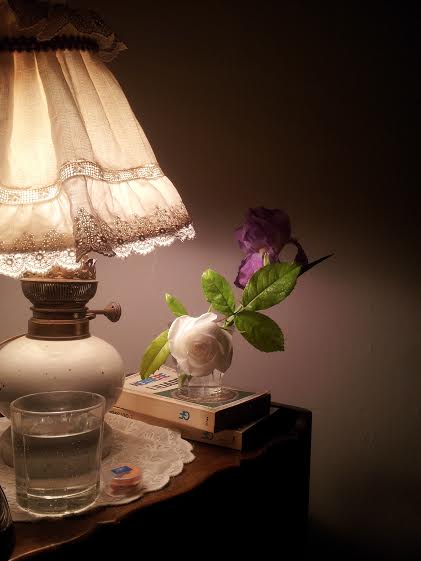
Strange how you can be here and there. Here, California, where my neighbour's tree is casting large shadows on the back of his very blue house (I've only ever seen a man about). There, the Vaucluse, where my daughter is spending a few days, and sends another picture of flowers, a rose and an iris. The scorched lampshade is a remnant of family history.

Wild flowers, the Vaucluse

Somewhere, recently, I read how John Cage, living in a cacaphonous place, decided to use the noise, not hate it.  

I think of this when I think of the differences between the sounds of living in a Bay Area suburb (commuter train whistle, leafblowers, birds, dogs, a bicycle swishing past) and living in downtown Paris (jackhammers, bells, honking cars, loud arguments, one-sided (cell phone) or two (homeless person with passerby). On the whole I prefer the multi-layered city noises...

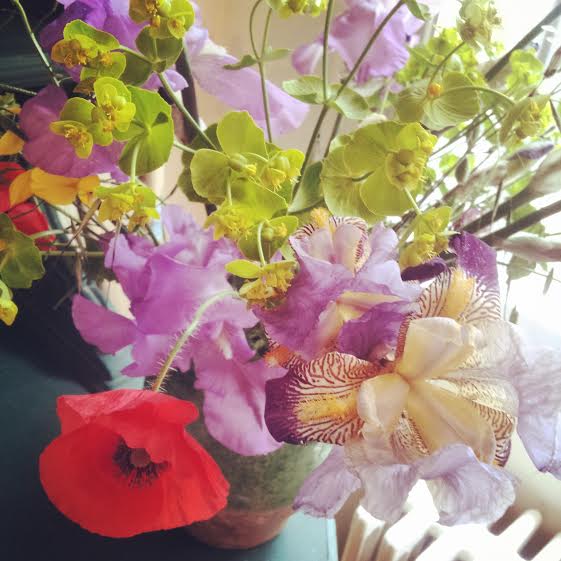
My science writer daughter (@catBrahic) is in the south of France for a few days, picking field flowers, even if--I think--the weather has been wet and/or windy. Here's today's bouquet: 

Blanchot, The Book to Come

Reading vol. 3 of Beckett's letters, I come across an admiring reference to Blanchot's The Book to Come (1959, for the original French) and borrow it from the library. The due date sticker in the inside back cover--this sticker, which belongs to the glue-and-paper economy, is an astonishing remnant of childhood libraries, the due-date card, not glued in, but sitting in its manilla pocket--the due date stickers in Blanchot show that this book has been checked out and in many times. Often, when I check out a book, a poetry book, for instance, I  notice that I am the only person who has ever checked that particular book out, and I wonder how many writers go to libraries and surreptitiously see how often their books have been borrowed. 

Blanchot,  page 110 (English translation) :  "Each time that in some new book we grasp again the solitary and silent assertion of the novel understood as the exception...we experience the feeling of a promise and the exultant impression that a new writer, having touched a limit, has succeeded in displacing it and perhaps in fixing it further ahead. [...] These works are rare, fugitive. [...] Some are modest. But all, even the ones that efface themselves, have this strength that comes from a new contact with 'reality'."

It occurs to me that Knaussgaard's My Struggle may be one of these books.

Sunday sounds

Sirens in the distance: I picture big red trucks racing somewhere. We hear them far less often now that we aren't living on the university campus, where they seemed to respond to several proto-emergencies a day in our neighbourhood of fraternity houses and eco-Franco-Italian-mitteleuropa residences. Figures, I guess. All those high-risk 20-year-olds.

Birds. Caltrain, whistling its way from San Francisco to San Jose, probably pretty empty on weekends, but full of commuters other days. It whooshes by two blocks west of us and there are level crossings everywhere with barriers that clang up and down. Every now and then a car gets stuck on the tracks in rush hour and, sadly, more often, someone jumps in front of the train, so the drivers are understandingly anxious. But at other times, the whistle sounds like an old time train whistle crossing the Canadian Prairies, then the Rocky Mountains and pulling into the old station in downtown Vancouver. When I was a student I used to work summers at a lodge in the Rockies and when we were off work we'd go into town and eat soft ice cream and watch the train go through. Steam. With porters.

Reading Le Monde this morning, I see that Saint Exupéry is the favourite author of French high school students, which reminds me of how much I loved his books when I was twenty and makes me wonder what it was about them. Wind, Sand and Stars (Terre des hommes): the lyrical Sahara desert landscape, I think. Maybe the affinity with night skies and the flat prairie wheat fields of Alberta and Saskatchewan.

Making it last

I interrupt a reading of Michael Hofmann's TLS review of Brecht ("Rescuing Brecht," 14 August 2014) to think what a pleasure it is to read Hofmann when, rarely, he can be wholeheartedly enthusiastic. It's not so funny, maybe, but it is more moving, and he does praise as beautifully as he does disparagement and is convincing in both modes (worth mentioning because William Logan is not especially good at praise, as his article on Pound in this month's New Criterion demonstrates, again).

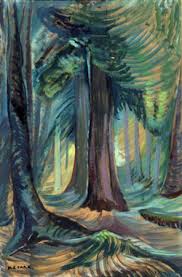
It rained the night before last. I had almost forgotten the sound. I had got up for a pee and I lay down on the living room floor with the door to the deck open a crack--it has turned cold--and listened to it for a while, then went back to bed and listened to it some more. When I was growing up in British Columbia, I don't think I would ever have thought that one day I would love the sound of rain--the rain that produced Emily Carr's dark, sun-filtered Douglas fir rain forests-- but I do.