Hiatus

Last week--no, make that last, last week--I was in Park City, Utah for five days, not shovelling snow--there's not been much precipitation in Utah this winter, any more than in California. I went for walks on the high desert hillsides near my daughter's home, hoping I might bump into a moose, but settling for scrub oak and sagebrush. The sagebrush is dusty grey-blue, the scrub oak still leafless, spiky, rough-barked and covered with orange lichen. It's only slightly taller than my head (I'm 5'6) when I'm walking and you wouldn't think it would provide cover for a moose, but it does, so I was keeping my eye on my daughter's two black labs when they darted off into the thickets. But no moose, only other dogs and humans running, walking, on dirt bikes. The sky was that incredibly solid blue that my mother always used to refer to as 'prairie sky' as she looked with some disdain at our west coast cloud cover, up in Vancouver.
Larkin

I've been reading bits of Larkin lately. A couple of years ago I left my thick, cumbersome Collected on the shelf in Paris and brought the thin individual books back to California, and it's a pleasure to take down The Whitsun Weddings with its old foxed, crumbly paper. The price tag, red, is in pounds, but I forget where and when I bought it. But I like the size of it, especially compared with increasingly thick books of contemporary poetry (including a couple doorstops I'm reviewing at the moment) with far too many poems.

But what I wanted to say is that I used to find Larkin condescending, and now I think that less. I see where the personal enters poems that once seemed to me to be looking critically at others: "Faith Healing," for instance, which I've just reread. It's a poem about gullibility, and desire, perhaps based on a tv broadcast, and Larkin, when I look close, is himself there is the sheepish crowd of desirers. I might not have seen that before.

          . . .  An immense slackening ache,

As when, thawing, the rigid landscape weeps,

Spreads slowly through them--that, and the voice above

Saying Dear child, and all time has disproved.

Coming home each evening

When I come home from campus on my bike in the evening, there's a moment when I make a left turn off a busy street onto a quieter one, and this quieter street, half commercial, half residential is lined with trees in bloom. The air is mild, the trees smell good. The houses are a mixture of small condo buildings and cottages for the workers building Stanford University a hundred years ago: a single story in wood with stairs up to a shady front porch where people keep chairs to sit and watch the world go by. One of them must be rented by a group of post-university young people, because I see them sitting around a table on the porch late in the day, and when I go by earlier, the remains of their dinner, glass, a been can, are still there. 

Windhover

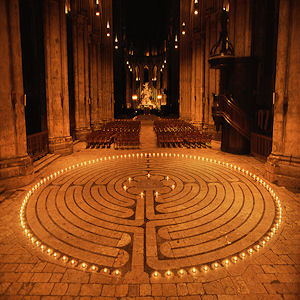
If you are feeling wrath- or resent-ful, here's a good place to clear your head. I used to bike past it last summer, before it opened, but Friday I went in and sat there for a while. Outside there is a reproduction of the labyrinth in Chartres Cathedral, which I walked around, cheating a little.

Nathan Oliveira is the painter of the Center's canvases, which were inspired by Hopkins' poem, which we all learned in secondary school, in my case, Grade 11 or 12, with Miss Bedford-Jones, who was the headmistress and whose 12th grade English classes were something to look forward to during all the earlier years:

I CAUGHT this morning morning’s minion, king-

  dom of daylight’s dauphin, dapple-dawn-drawn Falcon, in his riding

  Of the rolling level underneath him steady air. . .

Resentment

Yesterday was the last session of PRG (Philosophical Reading Group) for the academic year. PRG meets 2/3 quarters, around a single book. It's open to lots of people but most are grad students and faculty. I've attended sessions on Camus, Genesis and now, Simone Veil, whose really extraordinary essay on Force and the Iliad we were reading last night, along with an essay by Rachel Bespaloff, also on the Iliad.

The question of Achilles' wrath, which Bespaloff refers to as resentment, came up. Afterwards I went on trying to define for myself the difference between anger and resentment. Nietsche, of course, says that resentment is felt when there is an imbalance of power: the weaker party feels resentment. Someone said, during the discussion, that he thought of resentment as petty. That is probably the common perception, but I wonder how true it is.

Jean Amery is his essays about surviving Auschwitz writes at length about resentment, and about how the wronged party in that situation wants / needs to turn back the clock, to somehow efface the wrong. The circumstances there are not petty. Resentment between individuals, but also between nations. The Irish against the English; the Germans after World War I's harsh reparations; Russians today against the US and Europe; Palestine... . 

Ubuweb

Here's a resource: http://ubuweb.com/

This as a result, though not absolutely direct, of going to hear Marjorie Perloff yesterday afternoon on campus. Her remit was to talk about conceptual poetry at the Hebrew Conference: Written Word, Spoken Word ; she began with O'Hara's Lunch Poems  and ended with Kenneth Goldsmith's Seven American Deaths and DisastersGoldsmith is the founder of Ubuweb, a resource for the avant-garde and outsider poetry. Ubuweb would be great to have along on a 12-hour transatlantic flight. As you will see if you check it out.

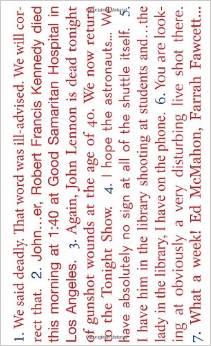
The image is the cover of Seven American Deaths and Disasterspublished by Powerhouse Books, 2013.

Little Story


Knowing he would be at the seminar I gave the noted professor a copy of my newly translated book by our mutual friend, the great French poet. He was at the head of the seminar table; I took a seat on the sidelines. After riffling the book's pages, he glanced over at me and asked, "Is this from him or from you?" "It's from me," I said.

Jean Améry

imgres.jpg

Back in January, in Paris, I was reading Sebald's On the Natural History of Destruction, about the Allied bombing of German cities at the end of World War II. Sebald is interested in how this devastation (600,000 German civilians killed, seven and a half million left homeless, x cubic meters of rubble per citizen in Cologne and Dresden...) "seems to have left scarcely a trace of pain behind in the collective consciousness...has been largely obliterated from the retrospective understanding of those affected, and...never played any appreciable part in the discussion of the internal constitution of our country." 

aclk.jpg

The third essay, "Against the Irreversible," is about Jean Améry (born "Hanns Chaim Mayer") and it led me to Améry's book: At the Mind's Limits, which I began to read last weekend. Améry thinks about what happens to the mind of an intellectual in Auschwitz; in the course of his musings, he has this to say about literature:

         "The first result was always the total collapse of the esthetic view of death. [...] the intellectual, and especially the intellectual of German education and culture, bears this esthetic view of death within him. It was his legacy from the distant past, at the very latest from the time of German romanticism. It can be more or less characterized by the names Novalis, Schopenhaer, Wagner, and Thomas Mann. For death in its literary, philosophic, or musical form there was no place in Auschwitz. No bridge led from death in Auschwitz to Death in Venice. Every poetic evocation of death became intolerable... . In the camp no Tristan music accompanied death [...] For the one expecting it, its esthetic embellishment in a way became a brazen demand and, in regard to his comrades, an indecent one."

There is much more. I am writing this down here, so I remember it, because it will stick better if my fingers are involved, along with my head.