Selfie

A review of Tom Lux's Selected Poems (Bloodaxe) in The Guardian a few days ago.

And a poem of my own in the Times Literary Supplement of January 9th:


       Degas’s Bather

The orchards of the internet have rooms

for my virtual museums, and portals

to fancies I suppress—Roman revels

enhanced with sound effects, like my neighbour

this noon in his condo, earthquake water

stacked prudently on his porch,

a redwood to shade our double windows. 


Sounds like he’s surfed a porno flick. Her yelps

ring out in waves like ripples a pebble

makes, plopped into water. And here’s the jug

she’ll sluice her back with in a second

or a century: longing’s embodiment

as I polish off my chicken breast, chased

with last night’s wine, my foraged plum.


Hélène Cixous, Chapitre Los

I am getting to the end of my translation of HC's book Chapitre Los (Paris: Galilée, 2013). This is the second or third or fourth draft, I forget, and I will leave it on the back burner now for a while, then revise it once more before I send it to Polity Press. I forget what my deadline is, sometime in the Spring, I believe.

I am still going back and forth between the English translation and the French text, but when I do the final read through, I will read only the English to make sure the book is rid of translationese, that it reads like an English book, an imaginative English book, if possible. This is not so easy as you might think, because Cixous doesn't write conventional French, and so the translation must sound unconventionally, experimentally English.

This morning, on page 88 of the French, I worked on this little prose poem, which can, I think, stand alone. Some context: Los is "about" (this is shorthand, I use the word advisedly) the death of Carlos Fuentes with whom Cixous had a "relationship" in the late 60s, and all her memories of him, of them, of the period (I abbreviate, the book is short but dense). She has been informed that her letters are part of his archives:

                        Los, a Chapter 

      "Letters. Ghosts they say. What a laugh. They are so much more alive than we        poor humans, our tired beings, our perishable bodies.

     I thought they’d stopped writing one another. But they go on, writing, talking, exchanging the news. When we forget they remember. That’s why we brought them into the world, to free them from our deaths. What is it to them whether we agree or disagree?

     Where? In numbered files. In boxes filthy as those goods trucks with immigrants stashed under their tarps, after they’ve crossed the planet.

     A part of your soul that completely escapes you and is sealed: a supernatural kind of dream, kept safe, out of reach.


     Under my name another."
Basketball

The boy next door (17-ish) has been shooting baskets in the backyard for hours. Soothing sound, pock pock pock clatter pock pock pock clatter. Also the train whistle: we live now between two suburban stations, and it whistles, old fashioned train whistle coming and going. Should I mention the suicides? Maybe not. Pock pock pock clatter. People jogging along a creek. Mothers jogging with babies in jogging strollers, mothers biking, pulling babies behind in little carts. Pock pock pock clatter. It'll be dark soon.

CNN

The CNN coverage of the Paris attacks is obscene. In a half-hour segment last time while I was at the gym, their personable journalists played the latest home-video of the shooting over and over, without once engaging in a serious debate about anything. And there are several intelligent debates going on here, not least in the Comments/Reactions section of Le Monde. What seems to slip under the radar of US media is the long history of European anti-clericalism.


Nous

means "I" (further to previous post).

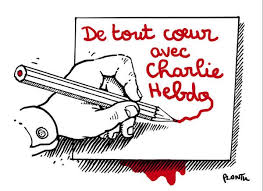
One of the interesting sidebars to the story of Charlie Hebdo is what mainstream newspapers, like Le Monde, The Guardian and The New York Times are saying and showing. Le Monde (Libération etc.have the whole story. The NYT somewhat self-righteously (I thought) said right after the attacks that they weren't going to print those crude cartoons which, for the newspaper of reference, is quite a statement, as even their own lawyer said, according to an article a day or two after the attacks. I don't know if The Guardian published pictures of the controversial cartoons because I've been in transit, but today there are articles in both papers about this week's cover: The Guardian shows it, The New York Times does not--in a video of today's CH press conference about the new cover, the Times coquettishly shows only a corner of it, like a bit of--not much--leg. But they do pornography different in France too. 

My gut feeling is freedom of speech should be stood up for. Thanks, Guardian, thanks Le Monde, thanks to perhaps the mainstream European press in general. I'd like to hear about the NYT's editorial discussions on the subject.  

Ok, maybe it's fine they aren't getting involved. Probably better they weren't over-present in Paris on Sunday. 

BTW, how--in 50 words--did we get here? It's easy to see what went wrong in the 2000s, but without going back to the beginning of the 20th century, or to the colonial period, or the Bible, what happened in the 90s (Clinton's presidency) to bring on 9/11? 

Nous sommes Charlie

What can you say that hasn't been said, mostly with utter banality, before? 'Horrible, terrible, shocking, barbarity'? I am embarrassed to used those words. They are too much and not enough. More seemly to just shut up. Or be there--somewhere--with a pen or a sign. Charlie Hebdo represents a few centuries of fighting for and achieving freedom of speech--it's not some symbol of late capitalism. It's a right, it's human. It's something we can agree on without feeling squeamish. We can say 'we' without wanting to add 'but.' 

'Nous Sommes Charlie,' the Air France pilot said on the intercom, touching down at San Francisco International yesterday afternoon, after he hoped we'd had a good flight.

Packing

To get out the suitcases or not to get out the suitcases, that is the question. Wait till the last minute, which is tomorrow, and put off thinking about leaving for another day, or stumble over suitcases for an extra 24 hours, but pack more slowly?

Normally we'd only have hand luggage. But we are moving to a new-to-us condo and thought we might take: a few sheets and towels, books, sofa cushions, books, salad bowl, tea towels, books, napkins, pot holders, books, placemats, books, a winter coat, books...ie, some of all the things (books) that are more than we need in one place. The model sailboat my son built. Books.

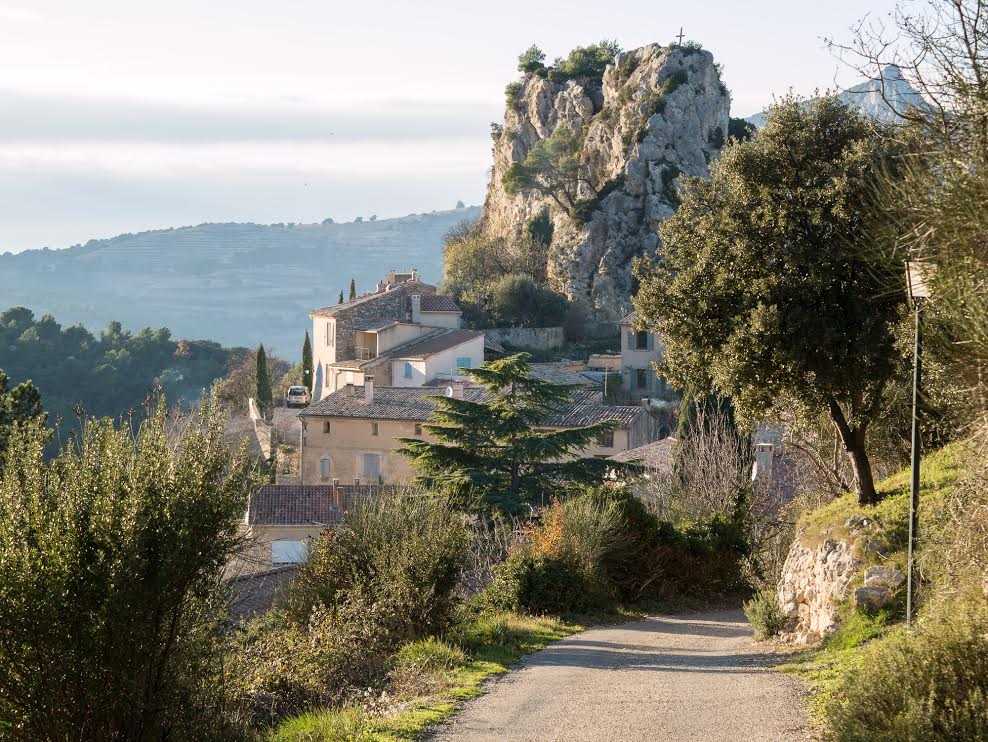
Here's another Christmas photograph. The village is La Roque Alric, looking towards the Dentelles de Montmirail, a great climbing spot. We walk there several times a week, 3.5 km of fairly steep up and down. In autumn there are vineyards with grapes to glean. In winter the mistral can be fierce, but the Place de l'Eglise, when you get there, is sunny and sheltered. In fact, you never want to leave. On this day a woman came along with a key to the church and we were able, for the first time, to go inside. She was taking away some of the Christmas flowers.

Photos by François Brahic

Photos by François Brahic

Michael Hofmann in the LRB

My December 18 LRB turned up a little late, but just dove into Michael Hofmann's review of Flanagan's The Narrow Road to the Deep North. What a pleasure to read even if, like me, you know nothing about the book. Case made. Thanks.

I happened to be working on a review of something myself, which I almost binned, but settled for deleting all the adjectives.