from Downtown Abbey to Breaking Bad

A year ago my daughter turned me on to Downtown Abbey. I don't have TV and I only agreed to watch because I'd read so much about it in the paper that I felt I should see at least one episode. Totally addictive, of course. I've even watched most of Season 3 (4?) twice, on my iPad. It got me across the Atlantic on at least one flight without complaining or standing up and screaming Let me out of here!

Then, in a rental up in the Sierras, while we (daughter, son, us) were hiking the Desolation Wilderness, I asked to see an episode of House of Cards on Netflix (no self-respecting rental in the backwoods would not have Internet, cable tv and Netflix). That was the same weekend I tried my luck at Candycrush. It took me about two weeks to watch all of House of Cards. And now I'm in the middle of Breaking Bad, which is truly extraordinary, so extraordinary that I wouldn't miss a minute of the credits even. I turn the sound down low or use headphones because I would be embarrassed if any of my neighbours heard all the shooting and screaming and wondered what was going on up here.
Delete, delete, delete

There is a story in the Times this morning about how scientists have figured out how to turn off the memory function in mice. Well, I exaggerate, a little. It involves inserting fiber optic wires into the brain and injecting a virus containing a protein. Thanks to this the scientists can switch neurons on and off and the mice forget all those bad mice memories that keep them from sleeping at night. This makes them happier mice.

And since we now know that there is only the slimmest difference between how mice work and how human beings work, in the not-too-distant future we too should be able to decide what and how much we want to remember. No Joyce, no Proust, no Kafka. 

I link this in my mind to another study I read this week, about how people tend to remember bad things much longer than good things. This fits my personal experience to a T, and I've often wondered why I was so perverse. We shouldn't take such experiences personally, I see--I often see, way after the fact--because they are hard-wired. One thing I have learned is that if you resolutely DON'T think about your setbacks, your failures, your humiliations, your tactlessness, you can ensure that these memories don't come back to plague you at 3 a.m. Wish I'd known this sooner--or maybe not. 

Would you rather be Socrates or a satisfied pig goes the old question in Philosophy for Beginners. I once thought the question was rhetorical. I'm no longer sure.

Why don't you put that book down and...

Kristof1.jpg

Just discovered, via a friend, a wonderful, new-to-me blog on books. And since I'm just back from the library, where I had the stacks pretty much to myself, let me list for my own future reference--I've taken to doing this in my agenda, whenever I think of it, so I can look back and say "I didn't know I'd read that." My Italian writer at the moment in my ongoing learn-to-at-least-read Italian project is La Coscienza de Zeno," --Zeno's Conscience /Consciousness--I'm assuming since in French that word could be taken either way, and I don't believe in looking up words until I'm really, really stuck. It's by Italo Svevo, who was a friend of Joyce's, if I recall. In the first long chapter he fails to stop smoking; in the second he married a woman after being turned down by all three of her sisters; and in the chapter I'm in the middle of (chapters are novella-length) he's juggling wife and mistress). 

I'm also binge-reading the extraordinary Penelope Fitzgerald and on the side some essays by Paul de Mann after reading a so-so but unputdownable biography of his life as a Nazi collaborator in his native Belgium and con-artist of various kinds in academia: Bard, Harvard, Yale. The essays are fascinating; easy to see why he was such a successful teacher of literature: he's passionate about books and writers.

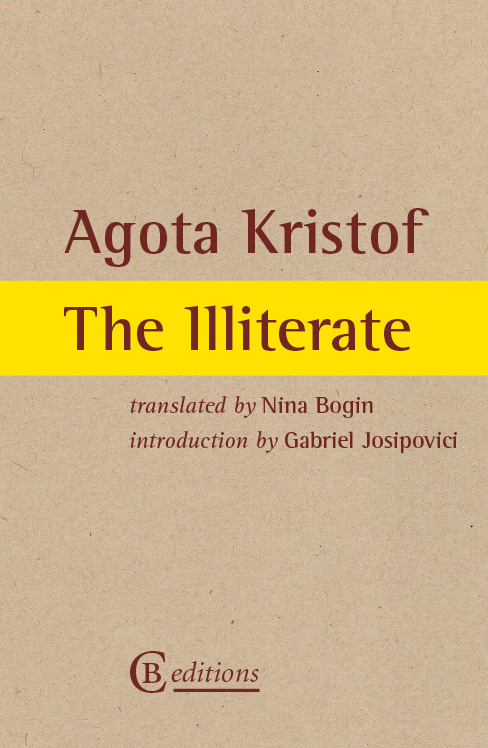
But the best book I've read all year is probably Agota Kristof's The Big Notebook, along with its accompanying text The Illiterate, in Nina Bogin's translation, both recently published  by CB Editions (republished in the case of Notebook). Kristof was a Hungarian who fled to Western Europe and had to learn to write all over again in French--how she did this is the story of The Illiterate. The Big Notebook is her stripped-to-the-bare-wood tale of a pair of twin boys abandoned to the care of the grandmother, one tough cookie, during the War (Second) and how they survived. It's terrifying and funny, one of my preferred combinations.

In Defense of Bookstores

Librairie Compagnie, Paris

Librairie Compagnie, Paris

One of the great pleasures of living in Paris is the bookstores. The one I drop into regularly is Compagnie, on the rue des Ecoles, opposite the Sorbonne. I can spend hours browsing among the tables on the main floor or downstairs. Just skimming the covers of the books with my fingers--a laying on of hands--feels good. I never walk by Compagnie without slowing down to window shop. And I buy a lot of books. This is something I don't do in California, in part because there aren't many bookstores I can walk to, and the one I can walk to sells baseball caps and mugs in addition to books, making feel like a pharmacy that has pushed the drugs to the back corner and filled the rest of the store with pop and Halloween decorations.

Besides it is simpler and cheaper to buy books from Amazon. So I do. But I don't in France, where a law prohibits discounting books, because France and a few other European countries, such as Germany, think a literary culture is worth protecting. And I concur.

Laws prohibiting discounts on books won't be enacted in the US--they would be unAmerican, un-free market. You would think, though, that a movement might be started in Ireland and the UK, with their long literary traditions. Surely these countries don't want to turn into nations of malls and chain stores. Such a movement might also be possible in other parts of Europe where such laws don't already exist. The present climate of anger with Amazon would be a good starting point.


Back

Back in business after a few weeks of looking for a solution to Redroom's abrupt end. Somewhat disturbing to be at the mercy of Redroom or another provider for the retrieval of one's content. But then, does one's content really matter? Other than to me, for whom it was a kind of journal.

It seems I can retrieve some of the blog posts, though it is going to be laborious. Meanwhile here is a new website, complete with blog. I am still learning how it works, so bear with me.

Don't Ask

I have this fantasy of "filling the holes" in my education. For example, recently I audited a seminar on Augustine's  Confessions. Which has led me to a biography of Augustine. Last night I read about the Sack of Rome. It percolated into my dreams.

This morning I thought I'd sharpen a few pencils before I began "work." I thought I'd read about the Sack of Rome. Naturally the Wiki entry is chock full of hyperlinks.

In 410 Rome was not the capital of the Roman Empire any more. Mediolanum (link) was: the city "in the middle of the plain"; ie Milan. I had no idea. Long reading about Milan in the first four centuries of our era. Link to

1) the Arian Controversy, named after a, it appears, divisive theologian called Arius. I resist the temptation to click on the Arius link, though really I'd like to know Arius's connection, if any, to a more recent Arian controversy. I don't resist the link to

2) the Council of Nicaea (325). Am I reading? No, I'm just skimming froth off the top of the pot (to tap a metaphor, which could lead to an exploration of metaphor as illumination / obfuscation /shortcut to things we can't otherwise kid ourselves we understand, but I won't go there...it's really murky territory...)

 The First Countil of Nicaea must have been fascinating, I'm thinking, reading about a couple dozen bishops arguing, with citations from Holy Writ, round a big seminar table about whether God the father preceded or came after God the son--the bishops came to blows, literally, and for a moment I expect to find a link to a YouTube of something like Wendy Murdoch throwing pies in court.

If I don't scatter a few crumbs in this forest I'm going to get completely lost. I'll never find my way back to the Sack of Rome. But how to understand the SR without all this context? This is how Tristram Shandy took so long to get born.

I'm reminded of our neighbour in the Vaucluse. Brigitte spent her evenings darning her son's socks by a frugal light. She was proud of her handiwork--socks that were more darn than sock. I'm not sure what this has to do with the above, but I feel it is relevant. Somehow.

Futbol

The sky is a cloudless blue this morning: it looks as artificial as the surface of a Jeff Koons balloon dog. Two nights ago we woke up to puddles of rain on the carport roof, outside the bedroom, and a damp deck out front. Unusual at this time of year.

The campus has filled with high school students doing academics and sports of various sorts--huge, colourful contingent of futbol (lovely word, can we keep it, to replace "soccer"?) players. I watched the second half of the U.S.-Germany game yesterday at the gym, an exercise in defense, I think, but with a good outcome; it will keep the U.S. interested in the next World Cup round. In many ways a more fun event than the Olympics--maybe that has something to do with Brazil? But also with the way "little" countries get star-billing? The Olympics are dead serious, the World Cup has sprezzatura, lightness, comedy. It's Hamlet against MNDream.

The TLS of 13th June has a poem by CK Williams, "Bark," (death as a friendly old dog) which is, as usual, crafty, but also a departure from CKW's usual syntax in the way it jams phrases together without the linking strategies of conventional English syntax, and yet makes perfect emotional and esthetic sense. Very different in many ways from the deconstructions of an Ashbery poem in the last (?) New Yorker. Ashbery is playful, CKW, fundamentally, isn't. CKW is the Olympics, Ashbery is futbol. I might be getting carried away.


Keywords:

Memory

Strange how the mind can rummage through its drawers and pull up a memory with all its sense detail from the layers of things stored there. I suppose one day, soon, we'll know how this works. Perhaps we'll be able to erase things: exercise selective amnesia. Neuroscientists are already playing with such possibilities, at least in animals.

I've been reading a book by the (East) German writer, Christa Wolf. I didn't know her work until recently when a friend who lives in eastern France suggested I read her. The book I'm reading is City of Angels,about a year-long residency in Los Angeles, and her anxiety about collaboration with the East German police, an episode she had completely forgotten and which was widely publicised when the archives were opened after German reunification. I believe it is the last book published before her death in (I think) 2011, but a novella August has just been published, post-humously, by Seagull Books.