Jean Améry

imgres.jpg

Back in January, in Paris, I was reading Sebald's On the Natural History of Destruction, about the Allied bombing of German cities at the end of World War II. Sebald is interested in how this devastation (600,000 German civilians killed, seven and a half million left homeless, x cubic meters of rubble per citizen in Cologne and Dresden...) "seems to have left scarcely a trace of pain behind in the collective consciousness...has been largely obliterated from the retrospective understanding of those affected, and...never played any appreciable part in the discussion of the internal constitution of our country." 

aclk.jpg

The third essay, "Against the Irreversible," is about Jean Améry (born "Hanns Chaim Mayer") and it led me to Améry's book: At the Mind's Limits, which I began to read last weekend. Améry thinks about what happens to the mind of an intellectual in Auschwitz; in the course of his musings, he has this to say about literature:

         "The first result was always the total collapse of the esthetic view of death. [...] the intellectual, and especially the intellectual of German education and culture, bears this esthetic view of death within him. It was his legacy from the distant past, at the very latest from the time of German romanticism. It can be more or less characterized by the names Novalis, Schopenhaer, Wagner, and Thomas Mann. For death in its literary, philosophic, or musical form there was no place in Auschwitz. No bridge led from death in Auschwitz to Death in Venice. Every poetic evocation of death became intolerable... . In the camp no Tristan music accompanied death [...] For the one expecting it, its esthetic embellishment in a way became a brazen demand and, in regard to his comrades, an indecent one."

There is much more. I am writing this down here, so I remember it, because it will stick better if my fingers are involved, along with my head.


Mild rant

Now that we don't get a newspaper on our doorstep in the morning--because we no longer have a doorstep--I find myself reading Le Monde as much as The New York Times on the ipad. Usually I read the one in Paris (on paper) and the other in the US, but the news from Europe--Greece, the Ukraine, anti-Muslimism, anti-Semitism--makes me want to know what the French paper is saying. Also there are two very entertaining stories in the Society (in the sense of sociological) section of Le Monde at the moment: the Bettencourt (L'Oréal) trial and the Strauss-Kahn trial.

And this reminds me of a partly satiric article Proust wrote (it is in the collection of odds and ends called Pastiches et Mélanges) about breakfasting with the previous day's news--the entertainment value of today's Figaro, which he found folded next to his croissant and his café au lait on his tray. Mind you, being Proust, breakfast was probably well into the afternoon.

Except for the pile of "read" paper in the front hall, I would much rather--having tried both--read a real paper in the morning, or evening (in the case of Le Monde, which appears mid-afternoon), than read the paper on line. I want a proper front page. More and more silly stories are turning up online in the "Top News." Not that I mind silly stories, I just prefer to find them in the silly sections.

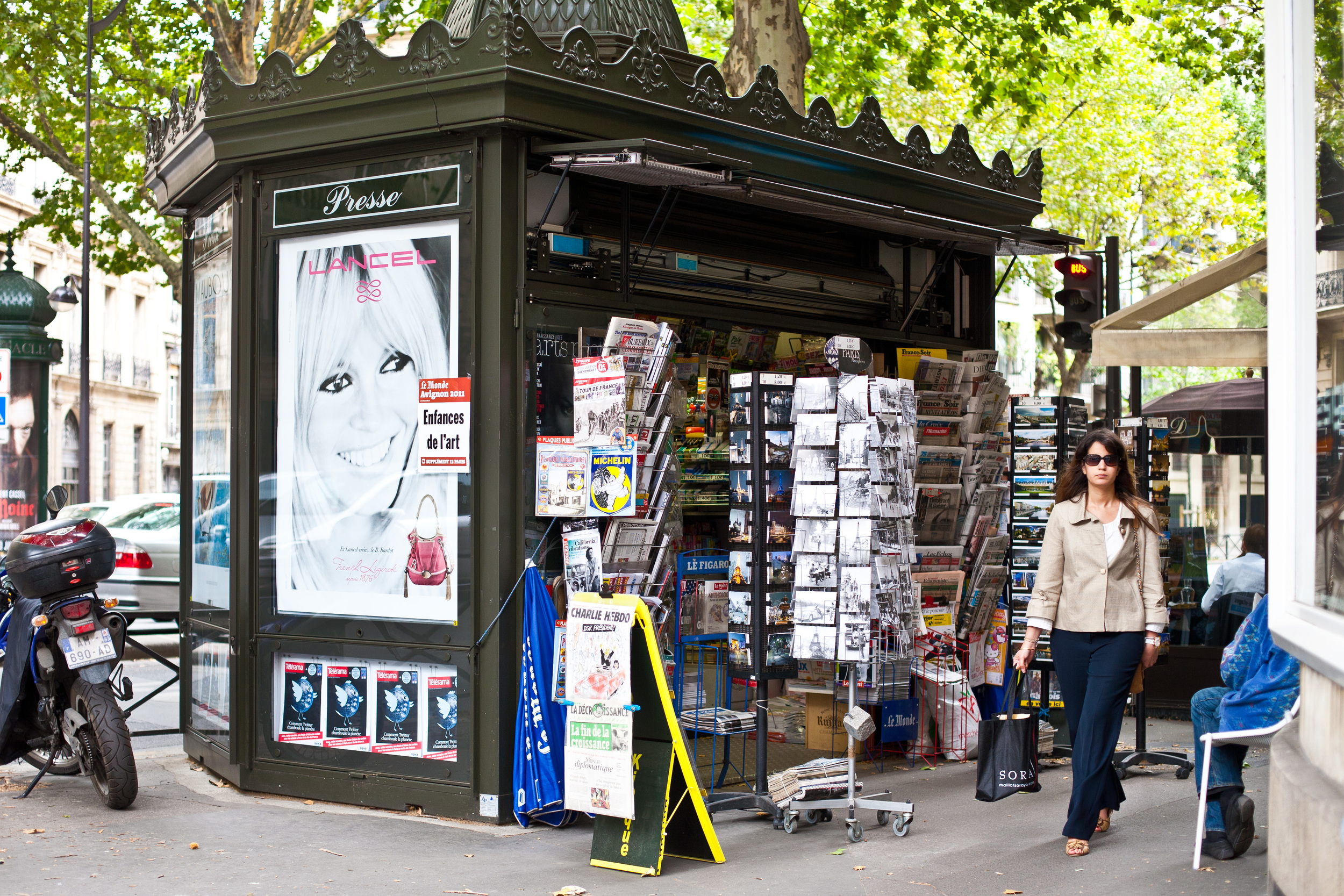
Besides it makes getting out of bed worthwhile when you can look forward to opening the front door and finding crispy fresh, still warm, reading material. And what would an afternoon in Paris be like if you couldn't have a quick chat with the newsie at the corner kiosk? The one Place de l'Odéon is a little grumpy, I grant you, but the one Place Vavin is charming, also the one...well you get the picture. Paris news kiosks are a whole world in themselves--not overlooking the underside of long hours, the cold and not, I imagine, much pay. The one pictured above, pinched from the internet, is St Germain du Près (dixit its caption), that is near the abbey and the two existential cafés where you can pay top price for coffee flavoured with exhaust fumes.

Cicadas

For a poem--perhaps--I was playing with cicadas and thinking of the south of France. 'Insouciant' popped up as a way to describe my cicada, emblem of summer in the south, reproduced in pottery and pins, heroine of the fable about the ant and the cicada (both feminine nouns in French). But the English dictionary gives 'insouciant,' a word that has intimations of joy and lightness in French, a negative turn: "showing a casual lack of concern; indifferent." So it goes,large cultural differences in a little word.

Cicada in Italian (now I'm on Wikipedia): 'cicala,' a children's word for 'vagina.' In China 'to shed the golden cicada skin' means to use deception, decoys, to escape danger. In Japan a symbol of reincarnation and ephemerality...

Are poetry books (US) too long?

Is it just me or are US poetry books getting longer, poems increasingly spaced out? I'm looking at a recent book from FSG: 103 pages long...but each page only contains 16-20 lines of poetry depending on how many stanza breaks there are. Beautifully set, of course, all that white space is like velvet under gems in a jewelry shop--or so I imagine, not having spent much time in jewelry shops.

So I looked at a couple of recent Faber poetry books. They tend to have fewer pages (51 for Maurice Riordan's new book; 85 for Heaney's Human Chain) but more lines per page. They still look good though. Maybe it all works out to the same thing? Maybe if the books are fatter the price can be higher? ($24 for FSG, 13 pounds sterling for FF).

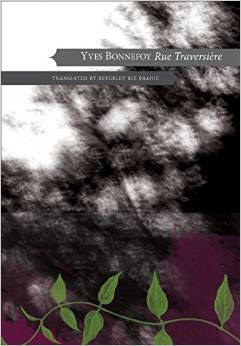
Yves Bonnefoy, Rue Traversière

I see my last post was about dishwashers--well, I'm done with Season 5 of Downton Abbey, but the dishwasher repair folk are still coming and going, and I afraid we may have to replace the dw because they can't keep making weekly visits forever, can they?

Aside from that, it's a pleasure to announce the publication of my translation of Yves Bonnefoy's collection of prose pieces (I say "pieces" because I'm not sure what other all-encompassing term--texts?--to use. A lot of these would fall into the category of prose poems, but others are more like personal essays, on dreams, on art, on travelling, on memory, on childhood, on some combination of all these things), Rue Traversière (Seagull Books). My copies arrived a week or so ago, and I have really enjoyed rereading them. Each of them, I think, has eternal value. This small book was originally published in the 70s, then YB added--as he often does--some more essays and collected it again as Rue Traversière and Other Dream Tales. I only translated the shorter, cohesive, poetic group of essays--for now--in part because I love the way it stands alone--the collection greater than the sum of its parts--as, in my view (it is unstable) a poetry collection should, a reason to admire the British way of publishing books of poetry that are sometimes only 48 pages long. 

Dishwashers come to Downton Abbey

The dishwasher repairman is here for the third time in two weeks. The dishwasher, an oldie we inherited along with the new apartment, of respectable brand, runs and runs until you turn it off and it is still bubbling with soapy water and greasy dishes. Once we turned it on a bedtime--high hopes after the first repair--and it was still running when we put the kettle on next morning. Silently, luckily.

Actually I don't mind washing dishes, since it is my husband who does them. And I do like drying and put them away, one of those tidying tasks, like ironing and sweeping up crumbs, that make the world feel like a safer place.

The third repairman is changing the computer board. Lots of pretty little colored wires and silvery appendages for innards, which make me think we will all be better off when we are robots. I'm a little nervous because he just excused himself to go and call his base. 

When he goes I get to make my fourth or fifth or sixth trip in two weeks to Ikea, ferreting out the actually-quite-pretty indispensable objects like Japanese-shaped small bowls for yoghurt (an interesting cross-cultural mix). I think I'm as hooked on Ikea as on Downton Abbey. I've watched all but the last episode of Season Five. Instead of watching the last one yesterday, I delayed and watched the second-to-last episode again, thinking: "all these soon-to-be happy couples upstairs and downstairs, what a novel! Only sad sweet Anna and Bates to keep us watching into the next season? Or will we still be watching in years to come? No, I guess not. Hard to keep Maggie Smith in the plot forever and so many happy endings waiting in the wings. What will the finale be? A wedding, the return-from-the dead of Edith's lover (no, she's going to be A Professional Woman), upstairs and downstairs meeting at--where could they credibly meet?

Cixous, Grosholz, Vines

Yesterday I finished translating Hélène Cixous's Chapitre Los.  I still have to make some corrections in the first part of the text, based on consultations with HC while I was in Paris. Then I shall leave it aside for a few weeks before I make my final run-through. When I do, I won't go back to the French text , because what I really want to see and hear is whether the text reads well in English, semantically, of course, but also musically.

Emily Grosholz, the poet and philosopher, and fellow translator of Yves Bonnefoy, has published a collection of poems called Childhood, with drawings by Lucy Vines. I was a little apprehensive when I picked up Grosholz's book, because, as a title for a book of poems, "childhood" seems a little forthright. Wrongly apprehensive, as I should have known. The poems are terrific, a mixture of intelligence and lyricism characteristic of Grosholz's poems,  which I've long admired. And Vine's drawings exist in a haunted, dreamlike mindscape of their own. They can also be seen at the Thessa Herold Gallery in Paris.