Crowds

Baudelaire's theme, or one of them. Of which my favourite poem is his sonnet "The Passerby," a classic anecdote about the person whose eye you catch in some public place, the person with whom you feel an immediate rapport, but whom you will never see again. In his case, and most often, in poetry, it is a man who sees a woman, This can be updated, not just the woman who sees the man, but any potential friendlover. When there is no erotic ping is perhaps the most moving: you have a sense of connecting with some other. It could be a dog you are about to euthanise...

But I was thinking about something else when I got onto this. How, when I walk down the Bd St Germain, among the crowds, I always find myself zigzagging to avoid the people walking against me. Why don't they zigzag, I think resentfully, why always me? So when they come on, I stop, I force them to flow around me.

But I have discovered the secret of walking in Paris crowds (does this happen in NYC, in London?): no one makes eye contact, but if you keep walking, at the last moment, everyone twitches their shoulder slightly, so that you pass without touching, though you feel the slight change in airflow.

I could compare this to crossing the street. In California, mostly the cars slow well before the crosswalk, if you are waiting to cross. Here, the cars stop--at the last possible second, and sometimes you need to look like you are going to walk right out in front of them: they aren't going to hit you, but if you have a heart attack, that's ok.
Shopping

There's always the Bon Marché (see Zola, Au Bonheur des Dames aka The Ladies' Delight for the story of the growth of a department store--or as in Babar  "The Big Store" (le grand magasin)--in c19 Paris) of course, nice to walk around, but only on a day you leave your purse and your appetite at home. I go there if I want something normally cheap and useful, a very nice tea towel, say, the one you hang on the oven and never use, but which matches the floor tiles and the set of mugs you found at Monoprix.

Monoprix! I haven't been there yet. It's a treat I'm saving. Monoprix on the Bd St. Michel, in between two branches of the bookstore, Gibert: papeterie and three floors of books, one on the corner of the rue Racine (which meets the rue Corneille at the Odéon) and the other on the corner of the rue des Ecoles. Groceries downstairs, scarves and face creams and toothpaste on the main level, and upstairs, clothes and colour-coordinated household goods, mugs, plates. Everything here changes every month or so, including the colours, and it's a great place to pick up a bargain whatnot or other. A pair of slippers. It's on my way to and from the gym, behind the Musee de Cluny, whose courtyard I ducked into yesterday. Sure enough the hot pink hollyhock was poking up through the cobbles, almost a weed, unplanned, but left to return again and again.

Sexy

I'm thinking how everything is sexier in Paris, but in particular, from a female perspective, the men, who dress in tight trousers and swing their hips. It looks good coming and going, or following. 

Also, lots of people on bikes, but no one--no one!--wears a helmet. Girls with their hair streaming behind them--a helmet would spoil that, but still, doesn't anyone care about the cars? 

Poems

I think I have a new manuscript of poems that I am provisionally calling "In-flight entertainment." But I've worked on it so much that I need not to think about it for a while and then go back and see if it still holds up, both the individual poems and the overall shape of the collection.

So in the meantime I am going back through old poems, the ones that were half-finished and left aside, ones I thought were finished but which I now see weren't, but which feel worth working more on--which, increasingly, means whittling them down to something barer and maybe rougher. Other activities--like looking at Duchamp, like moving to another part of the world, with the shocks, like translating or writing an article--help to see things differently. 

Can't always trust my judgement, however. A couple weeks ago I took a poem I'd pulled out of my own slush pile, and which surprised me by its rightness to a poetry group meeting over in Berkeley. Only my friends there weren't impressed by most of it--I'd been so sure it was a keeper, but there you go. I put most of it back in the slush pile. They are people whose judgement I respect.

The Bride Stripped Bare

Cooler and cloudy today in Paris, though the sun came out at the end of the afternoon, which I spent at the Centre Pompidou visiting the Duchamp exhibit. Crowded--today was the first Sunday in the month, I realised, and free. Still lots to learn about Duchamp and the show has several strong points, including a chronological treatment of his evolution from Fauvism to Cubism to his own particular brand of Cubism which involved not looking at an object from all sides simultaneously--though he did that too--but portraying something, a woman, two chess players at several different moments in time, and putting all the moments together on the same canvas, the most famous example being the "Nude Descending a Staircase." The last part of the exhibit showed the development of the Grand Glass, the Bride and her Bachelors. I knew the big well-known works, but it is very interesting to see the smaller, less well known works that link his different styles together and show how and why he evolved as he did. I remember once seeing a Mondrian show in The Hague that did the same.

All squished into too small a space for the number of visitors, given that there are a lot of very small pieces of paper to look at closely. Still, it's a key period in the history of c20 art, not just visual, and worth going back to, partly for Duchamp's own analyses of his development--say the way his titles moved from being descriptive to being thematic/allegorical to being utterly enigmatic and oblique.

Crossing the Place St Michel on the way home, I stopped to listen to a pianist playing a concert on a piano he had put in the middle of the square. His concentration and accuracy and verve were quite moving.

Honey

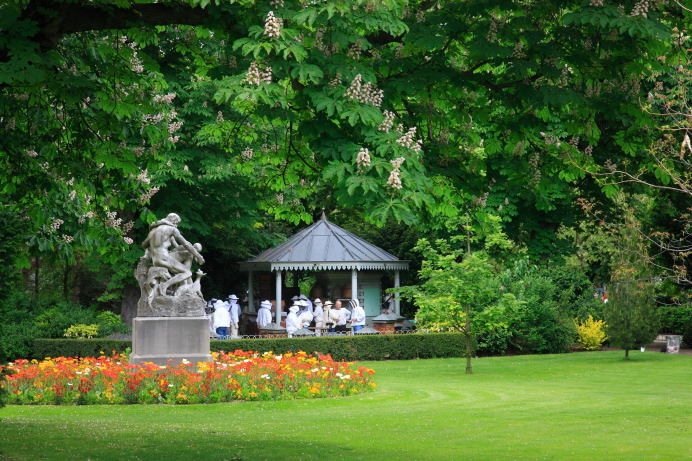
Every year the beekeepers of the Luxembourg Garden sell their honey to the public. It has a special flavour, maybe due to Paris pollution.

I thought today was the day. I rushed over with my cash. I even found one last cheque in my French checkbook, in case I didn't have enough cash (beekeepers don't take credit cards). Alas, I was wrong about the date. 

"It was last weekend," a lady sitting at a table in front of the beekeepers' clubhouse, a table spread with cookies and a pot of honey. She pointed to the poster above her head, which I'd already seen earlier this week. Sure enough--I was a week out. Crestfallen. But all these people lined up--weren't they waiting to buy honey? (Last year it was rationed; only 1 pot per family.) No, they were waiting to take the exam.

When I come back to live in Paris, I will become a beekeeper in the Luxembourg Garden. I will take the exam.

(I found a link to a blog about Paris's beekeepers, from which I borrowed my photo.)

Rituals (France)

Locking the public garden for the night. 

The Luxembourg Garden, which has a fence around it, an elegant fence with a number of gates that are closed at night, keeping the birds in and people out, is locked at sundown like many other French parks. There is a ritual for this; last night I stayed to enjoy it.

At about 6:15 pm (at the moment) policemen close the children's playground, a gated enclosure within the gated enclosure. You hear their whistles in the background over the noise of the children. More whistles, loud, short, shrill, playful, and fewer children's voices. The merry-go-round is wrapped up.

Now there is a half hour of quiet before--6:45 on the dot--the whistles begin again for the rest of the garden--a whistle off to the left, to the right, in the distance, coming closer--until the last chair is vacated, the last basketball-tossing kid throws his last shot, the last chess players gather up their board. Small children have gone, older ones head off on their skateboards, the petanque players put on their coats. People walk towards the exits, north, south, east and west. The joggers continue--I've been among them; you avoid catching the policemen's eyes until you've made it round for the last time and out the right gate. A policeman stands at each gate, keeping people from coming in--I've tried to do that too--if you are crossing the neighbourhood from west to east or vice versa, it is a good deal further when you can't cut across the Garden. The policeman will make no exceptions, the garden is closed, sorry.

Bonsoir Madame, the policeman says to the frowzy blonde woman in a mini-skirt. A demain.